TheJakartaPost
Please Update your browser
Your browser is out of date, and may not be compatible with our website. A list of the most popular web browsers can be found below.
Just click on the icons to get to the download page.


Popular Reads
Top Results
No results found. Please check your search term and try again
Can't find what you're looking for?
View all search results
Popular Reads
Top Results
No results found. Please check your search term and try again
Can't find what you're looking for?
View all search resultsThe irony of ASEAN’s new multipolar peace ambitions
The Russia-ASEAN Summit in Kazan recently showed how Southeast Asian leaders prioritized energy pragmatism over international law—and why they must find a more principled way to navigate a fractured world.
Change text size
Gift Premium Articles
to Anyone
Share the best of The Jakarta Post with friends, family, or colleagues. As a subscriber, you can gift 3 to 5 articles each month that anyone can read—no subscription needed!
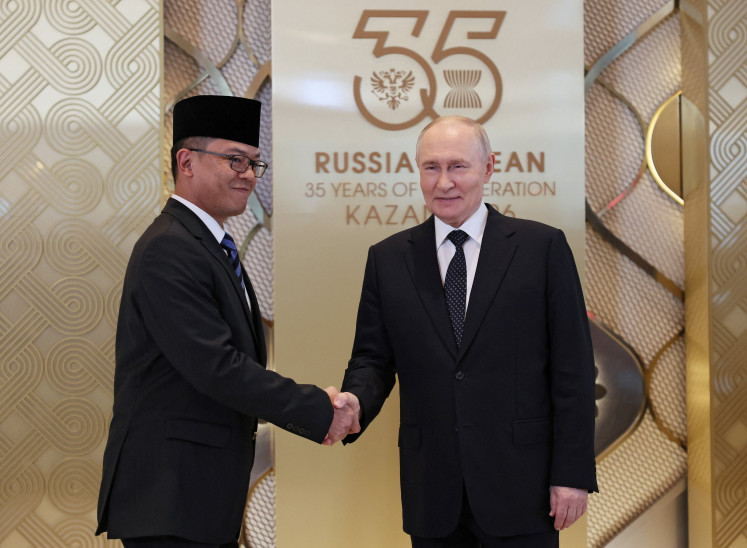
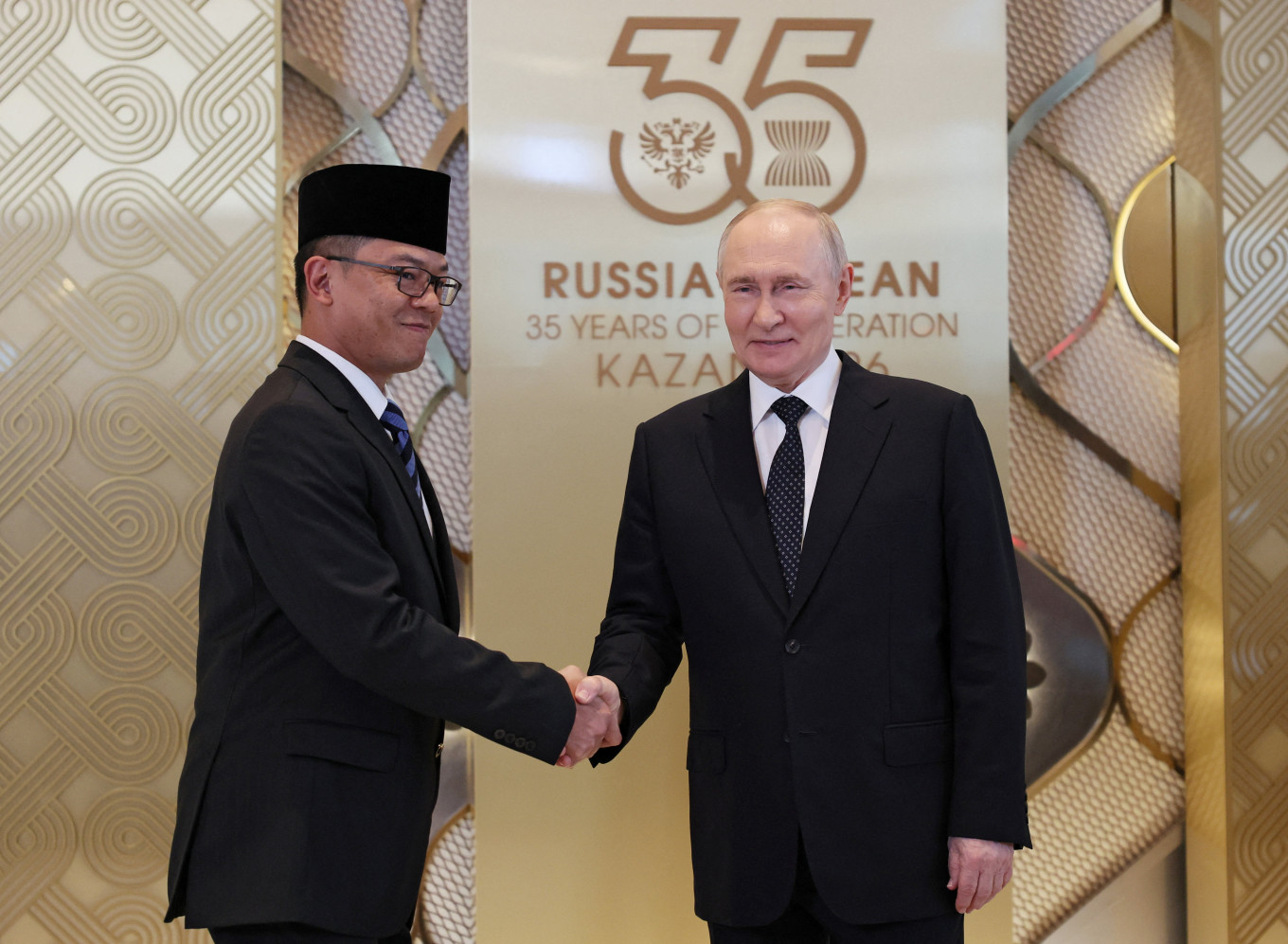 Russian President Vladimir Putin shakes hands with Indonesian Foreign Minister Sugiono during an official welcoming ceremony for the heads of delegations participating in the Russia-ASEAN Summit on June 17 in Kazan, Russia. (Reuters/Anastasia Barashkova)
I
n normal times, ASEAN should do whatever it can to expand and consolidate its bilateral and multilateral engagement. There is no doubt that Russia is a major power with an extremely important Asian dimension and a considerable geographical presence in the Asia-Pacific. Moscow has always been an important partner for ASEAN member nations, and the bloc's desire to pursue a stronger relationship should ordinarily be applauded.
But we are not in normal times. Feb. 24, 2022, tragically inaugurated a new era. On that day, Russian troops launched a military aggression against Ukraine—not a "special operation", but a real war defined by cruelty, terror and thousands of innocent lives lost on both sides.
I would be lying if I said I expected more from the ASEAN leaders who traveled to Kazan, a city of immense historical and cultural significance for Russia, for the ASEAN-Russia Summit. After all, it is difficult to harbor hope that ASEAN and its leaders would uphold the basic principles of national sovereignty while dealing with Russia. Yet, we must not pretend that nothing short of outrageous happened when ASEAN member states decided to accept the invitation to commemorate the 35th anniversary of their bilateral relations in person.
Ukraine is enduring horrifying sacrifices to stand against Russia’s egregious miscalculation. Whatever Moscow’s alleged grievances against Kyiv—some of which may be real, while others are simply the product of propaganda—they should have led to more diplomacy, not bloodshed.
It is true that for Southeast Asian nations, this invasion was never a top priority. It is also true that ASEAN nations have rarely championed human rights and democracy, especially in the domain of foreign policy. Still, it is a disappointment that must be called out.
Certainly, there were face-saving ways out of this delicate situation. For example, the summit could have been held online or scaled down to the Foreign Ministers' level. It is baffling that a core aspiration cited in the gathering's outcome, the Kazan Declaration, would actually be laudable if the Russian invasion had not occurred.

The text notes that both Russia and ASEAN share a “common aspiration, amid increasingly complex global challenges arising from geopolitical and geo-economic shifts, towards a just multipolar world as guided by international law and the principles of the United Nations Charter to promote mutual benefit and respect for all states.”