TheJakartaPost
Please Update your browser
Your browser is out of date, and may not be compatible with our website. A list of the most popular web browsers can be found below.
Just click on the icons to get to the download page.


Popular Reads
Top Results
No results found. Please check your search term and try again
Can't find what you're looking for?
View all search results
Popular Reads
Top Results
No results found. Please check your search term and try again
Can't find what you're looking for?
View all search resultsTime to upgrade our digital public infrastructure
We have built exquisite digital systems for entertainment and consumption, yet the infrastructure governing food, water and health remains tragically under-designed. It is time to move past static government websites and build real-time public ecosystems that transform data into actual human wellbeing.
Change text size
Gift Premium Articles
to Anyone
Share the best of The Jakarta Post with friends, family, or colleagues. As a subscriber, you can gift 3 to 5 articles each month that anyone can read—no subscription needed!
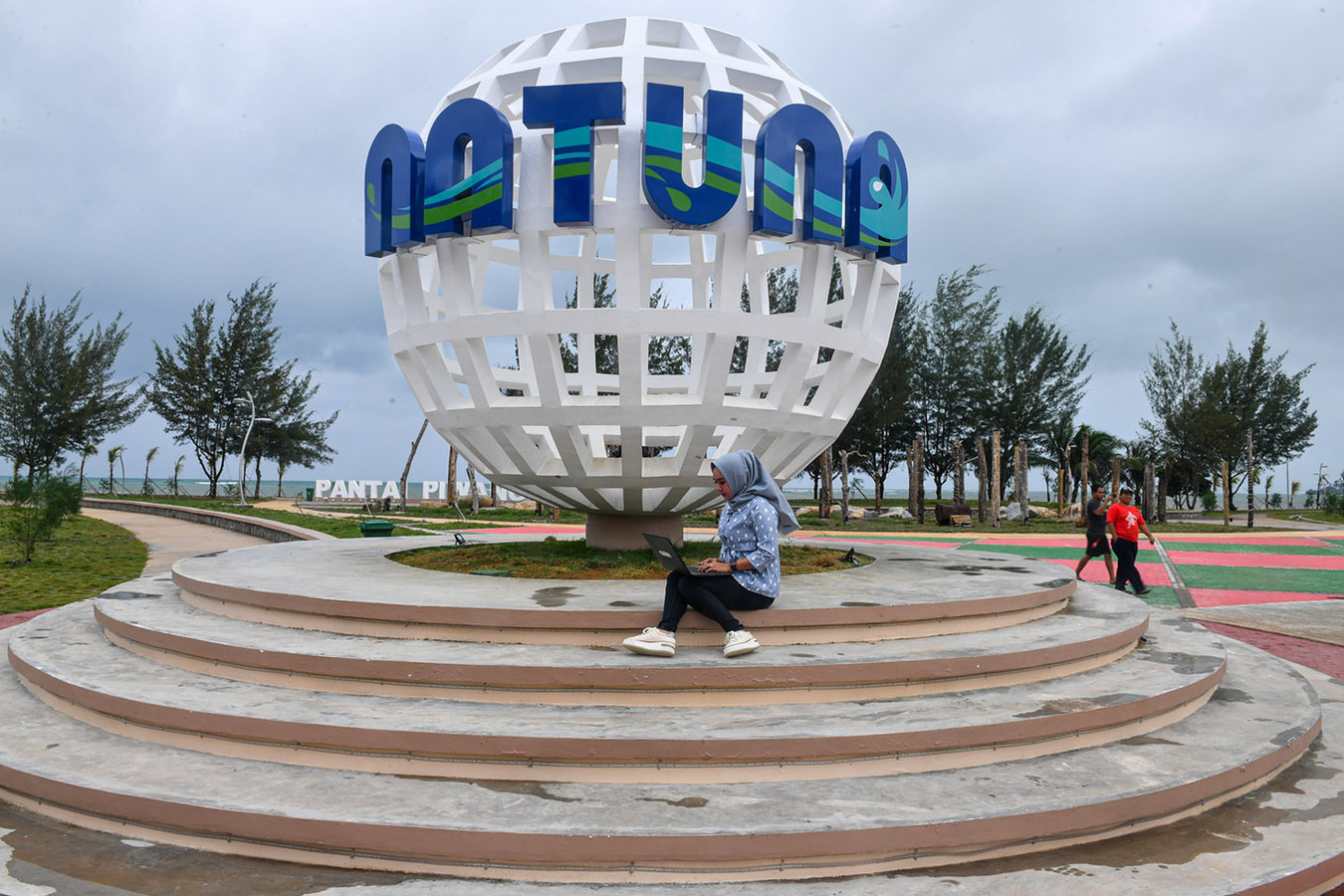 A visitor operates his laptop using a free wireless internet network on Jan. 14, 2020, at Piwang Beach, Natuna, Riau Islands. The local government provides eight free wifi points in public places thanks to the operation of the West Palapa Ring (PRB) satellite. (Antara/M Risyal Hidayat)
W
e typically think of infrastructure as roads, bridges and water lines. There is a saying: if you want to connect people and markets, build roads. But in today’s world, connecting people to knowledge, finance and opportunities requires building Digital Public Infrastructure (DPI) or knowledge commons.
Knowledge and data are everywhere, but without internet access, they cannot be leveraged for learning or earning. For example, the Food and Agriculture Organization (FAO) publishes an annual Food Balance Sheet, providing free agricultural data for over 245 countries dating back to 1961. Yet, this extraordinary public good remains useless to a young person in a remote rural area who lacks connectivity.
Furthermore, a national balance sheet shows macro-level food availability, but it cannot reveal whether a specific village lacks nutritious food, whether a household falls below minimum dietary levels, whether local soil health is collapsing, or if public programs are reaching the right families. In an age of satellites, smartphones and mobile data, this is a profound failure of public infrastructure. When the many cannot access what the few take for granted, systemic inequality deepens.
This is not a critique of intent, but of pace. Bureaucracies naturally lag behind technological innovation, while the private sector races ahead. Consumer technology is now intuitive, predictive, and personalized. Private platforms often predict what we want to buy, watch, or eat before a government knows if a household has clean water, secure housing or basic healthcare. For instance, ChatGPT scales to hundreds of millions of weekly users through private capital and disciplined product design. By contrast, many public systems still require citizens to download forms, upload scans, visit physical offices and repeatedly provide the same data across departments.
This imbalance creates a strange civilizational asymmetry: humanity has engineered exquisite systems for advertising, entertainment and financial speculation, while the systems governing food, water, soil, health and livelihoods remain fundamentally under-designed.
Public goods are everybody’s responsibility but nobody’s product roadmap. Data is repeatedly collected by siloed agencies but rarely integrated or made actionable for ordinary citizens. Ministries operate schemes, NGOs run projects and researchers publish studies—yet this knowledge rarely compounds into a living public intelligence system.

India’s Unified Payments Interface (UPI) demonstrates what is possible. By bridging hundreds of banks and processing tens of billions of transactions worth billions of dollars monthly, it empowered over 1.4 billion users. UPI succeeded because the government set open standards and fostered an ecosystem where banks, fintechs, merchants and citizens could interact seamlessly.