TheJakartaPost
Please Update your browser
Your browser is out of date, and may not be compatible with our website. A list of the most popular web browsers can be found below.
Just click on the icons to get to the download page.


Popular Reads
Top Results
No results found. Please check your search term and try again
Can't find what you're looking for?
View all search results
Popular Reads
Top Results
No results found. Please check your search term and try again
Can't find what you're looking for?
View all search resultsIndonesia as the missing partner in Pacific development
A more structured trilateral framework involving Indonesia, Australia and Pacific Island countries would likely be more effective than fragmented bilateral efforts.
Change text size
Gift Premium Articles
to Anyone
Share the best of The Jakarta Post with friends, family, or colleagues. As a subscriber, you can gift 3 to 5 articles each month that anyone can read—no subscription needed!
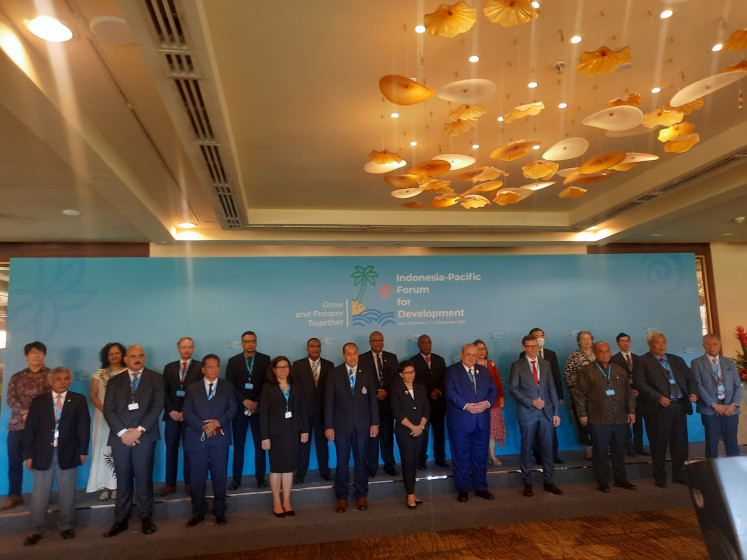
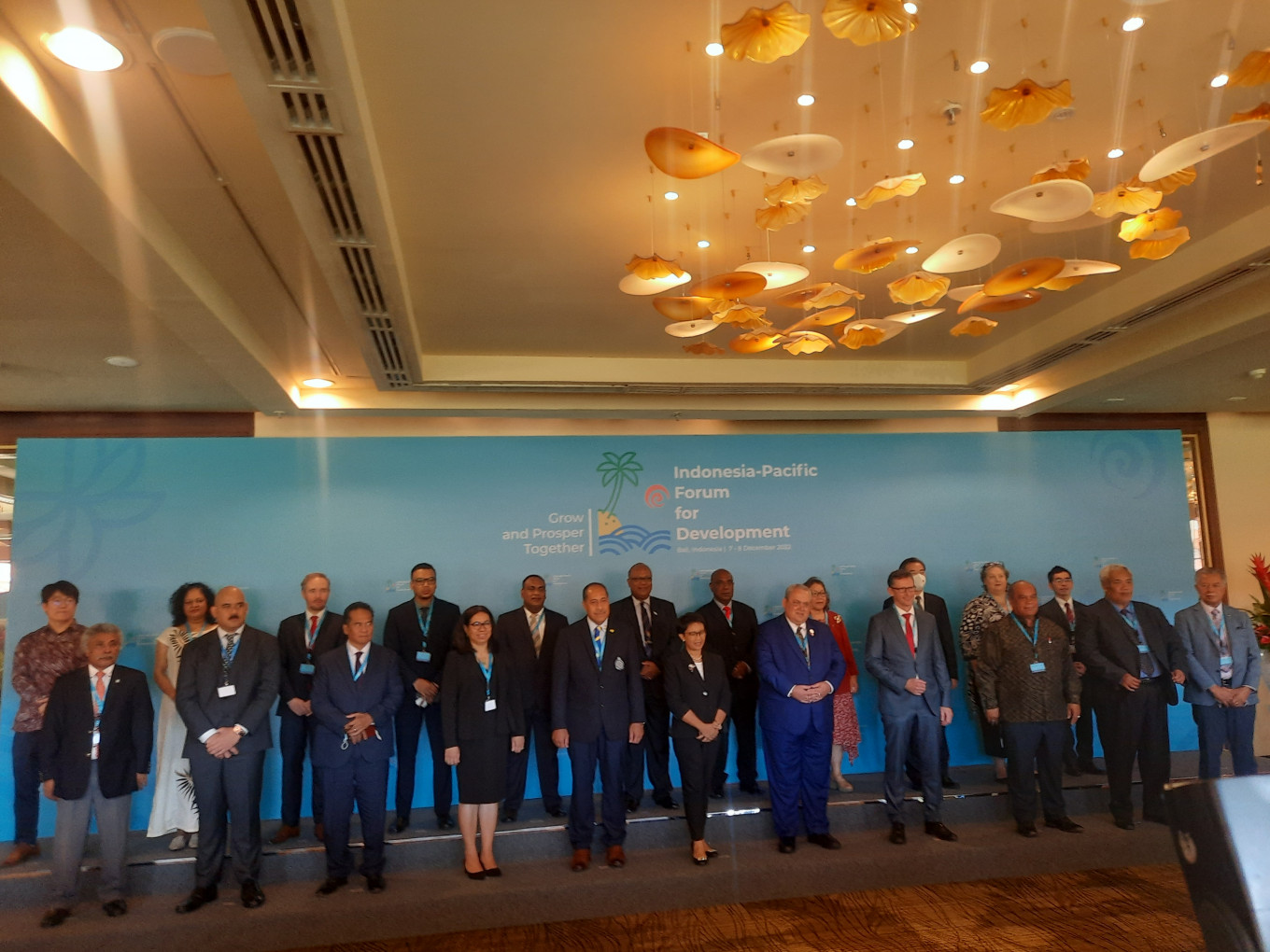 Foreign Minister Retno Marsudi (front center) and ministers, senior officials and representatives from Pacific countries and intergovernmental organizations pose for a group photo during the Indonesia-Pacific Forum for Development High Level Dialogue on Wednesday in Nusa Dua, Bali. (JP/A. Muh. Ibnu Aqil)
T
he Pacific is attracting unprecedented international attention. Yet for many Pacific Island countries, the central concerns are less about geopolitical rivalry than economic opportunity, climate resilience, digital connectivity and jobs.
As one of the world’s largest archipelagic nations, Indonesia has navigated many of the same constraints these states face today. Its experience often aligns more closely with Pacific realities than models drawn from wealthier economies. By aligning its engagement with these priorities, Jakarta can both support regional development and strengthen its own position across the Pacific.
Indonesia also shares deep ethnic, linguistic and cultural ties with Melanesian communities across the region. Indonesians live and work throughout the Pacific, and people-to-people links have expanded steadily over recent decades. Government-to-government relations, however, have not always kept pace. West Papua continues to shape perceptions of Indonesia in some Pacific capitals and has at times overshadowed broader areas of cooperation. Yet a relationship defined by a single issue risks obscuring wider shared interests.
Jakarta has sought to deepen its Pacific engagement through its Pacific Elevation agenda and broader South-South cooperation initiatives. The next phase of engagement should therefore prioritize practical partnerships that address local priorities and generate tangible results. This is where Indonesia holds a comparative advantage. It can offer something neither Western development partners nor China can readily provide: development experience shaped under conditions similar to those of many Pacific Island states.
Education is one area where this advantage is particularly evident. Many Pacific countries face limited access to higher education and rely on a small number of regional institutions with constrained capacity. Indonesia, by contrast, has built one of the world’s largest university systems, with a growing number of institutions gaining international recognition and offering degree programs taught in English. The presence of foreign universities, including Australian institutions, is further strengthening the sector.
For decades, Australia and New Zealand have been the primary destinations for Pacific students pursuing tertiary education. Indonesia has an opportunity to emerge as a credible alternative, combining lower costs with steadily improving quality.

Expanding scholarships for Pacific students, including through the Developing Countries Partnership (KNB) Scholarship, would be an investment in long-term regional influence. Educational exchanges build relationships that endure across generations. Pacific leaders, civil servants and business executives are more likely to view Indonesia as a trusted partner if they have studied, lived and built professional networks in the country.