TheJakartaPost
Please Update your browser
Your browser is out of date, and may not be compatible with our website. A list of the most popular web browsers can be found below.
Just click on the icons to get to the download page.


Popular Reads
Top Results
No results found. Please check your search term and try again
Can't find what you're looking for?
View all search results
Popular Reads
Top Results
No results found. Please check your search term and try again
Can't find what you're looking for?
View all search resultsThree flaws, one solution: Ending child labor in Indonesia
Behind Indonesia’s improving statistics lies a harsh reality of over one million children hidden in an unregulated, informal economy. To save them, the government must democratize local data and force its siloed ministries to cooperate.
Change text size
Gift Premium Articles
to Anyone
Share the best of The Jakarta Post with friends, family, or colleagues. As a subscriber, you can gift 3 to 5 articles each month that anyone can read—no subscription needed!
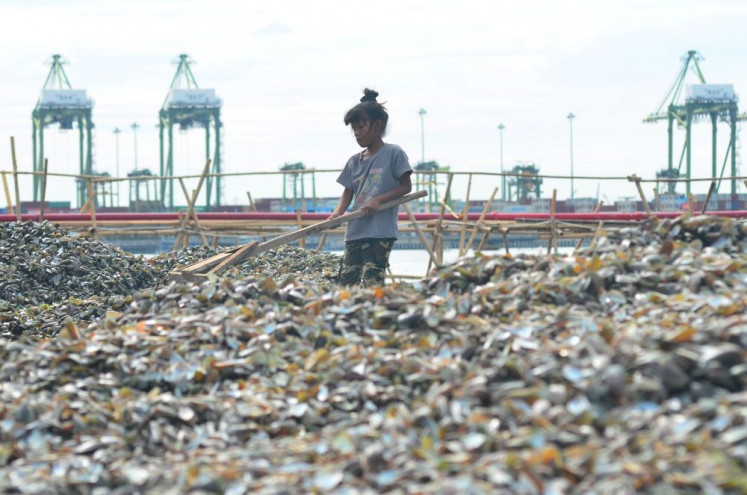
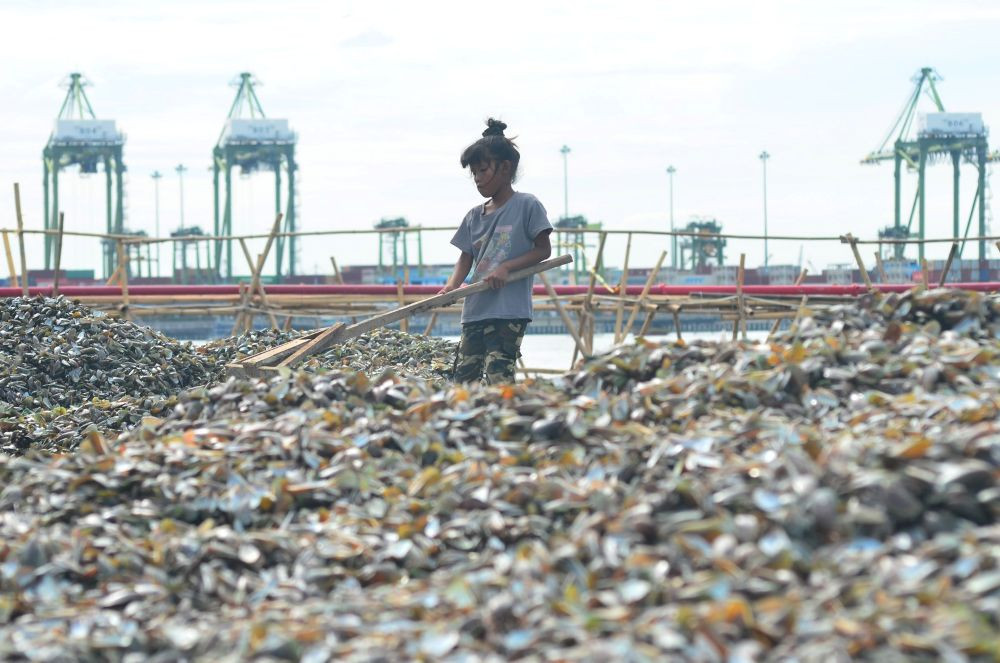 Waste no time: A teenage girl arranges piles of discarded shell waste on Oct. 25, 2025, in the Cilincing area of North Jakarta. Child labor remains a challenge facing the country’s poverty alleviation drive. (JP/Iqro Rinaldi)
E
very year on June 12, Indonesia joins the global community in marking the World Day Against Child Labor. While official figures show the number of child laborers declining from roughly 1.27 million in 2024 to 1.05 million in 2025 alongside rising school enrollment, reality on the ground tells a harsher story.
Each day, countless children begin work before sunrise: sweating on plantations, operating within hazardous, unregistered home industries, singing or begging on city streets or scavenging in landfills. Because they operate entirely outside the formal employment system, they remain invisible to the country's protective legal frameworks.
Three systemic bottlenecks prevent Indonesia from eliminating this crisis: endemic informality, fragmented national statistics across ministries and a fundamental lack of institutional coordination.
Critics often argue that informal employment is an inevitable economic cushion for the poor. However, the deepest layer of this ecosystem - often classified as "Tier Three" informal work, where economic activity is entirely unregulated, unregistered and untaxed - is not a mattress of economic flexibility. It is an arena where the state evades its obligation to protect its youngest citizens.
In Indonesia, deep informality breeds willful ignorance. Unregistered child laborers possess no legal identity on the job, stripping them of age certifications, health inspections, workplace safety standards, minimum wage protections or dispute resolution mechanisms. Informality, in short, is an escape from state accountability.
The antidote is the implementation of an affordable, penalty-free data collection mechanism targeting informal workplaces. By bringing these invisible children into the light, the government can effectively deploy targeted interventions, linking registration to conditional cash transfers, education allowances and localized social safety nets. By bridging identification with immediate family assistance, Indonesia can build a tangible pathway out of economic dependency.

Some policymakers claim that data from the National Workforce Survey (Sakernas) conducted by Statistics Indonesia (BPS) is sufficiently precise. But statistics lose their utility when locked behind bureaucratic vaults.