TheJakartaPost
Please Update your browser
Your browser is out of date, and may not be compatible with our website. A list of the most popular web browsers can be found below.
Just click on the icons to get to the download page.


Popular Reads
Top Results
No results found. Please check your search term and try again
Can't find what you're looking for?
View all search results
Popular Reads
Top Results
No results found. Please check your search term and try again
Can't find what you're looking for?
View all search resultsSustainability rhetoric vs. economic reality: Can we square the circle?
Global economic shocks and climate volatility are no longer temporary disruptions; they are structural crises deeply embedded in our strained natural systems. For resource-rich nations like Indonesia, surviving the next shock requires rewriting the global incentive structure to value nature on the national balance sheet and fairly compensate the smallholders on the front lines.
Change text size
Gift Premium Articles
to Anyone
Share the best of The Jakarta Post with friends, family, or colleagues. As a subscriber, you can gift 3 to 5 articles each month that anyone can read—no subscription needed!
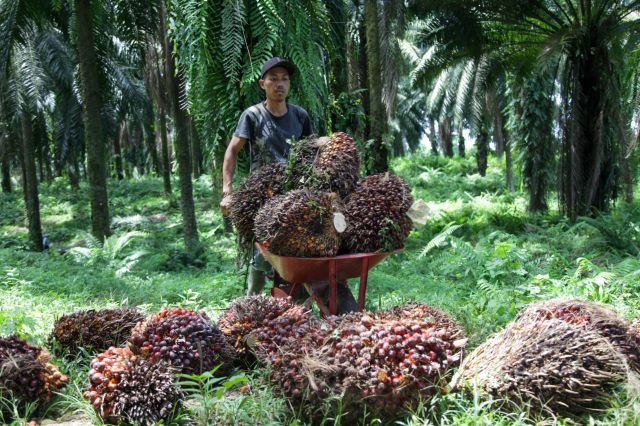
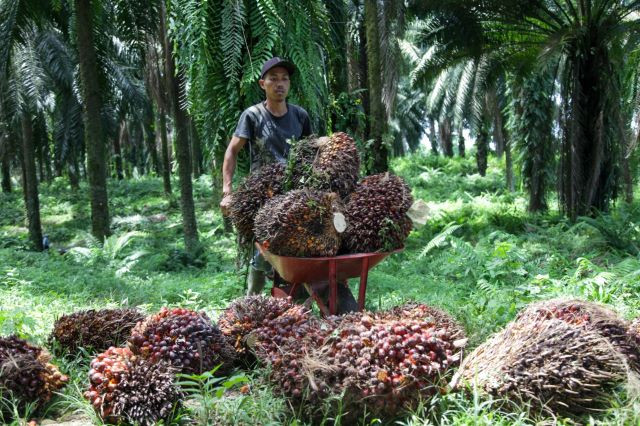 Good haul: A worker harvests fresh fruit bunches (FFB) on May 12, 2022 at the Namorambe oil palm plantation in Deli Serdang, North Sumatra. (AFP/Andi)
T
he recent military escalation in the Middle East has shown, once again, how quickly shocks travel through the global economy and across markets, and are felt locally. Net oil importers suffered fiscal pressures, while increasing fertilizer prices will ultimately raise food prices almost everywhere. For the poorest households, which spend most of their income on essentials like food, it translated into an affordability shock almost overnight.
These episodes are often treated as temporary disruptions, but they reflect something deeper and structural. Around 90 percent of people globally live with degraded land, polluted air, or water stress—evidence that shocks occur within already strained systems. Food systems, energy systems and ecosystems are deeply interconnected. When one is stressed, effects cascade across the others.
The health of the “next crop” illustrates these systemic linkages. If costly fertilizer remains out-of-reach for small farmers, output falls and incomes suffer. Yet, overuse elsewhere is already eroding productivity: half of global food supply is produced in areas where nitrogen use reduces yields, while pollution costs reach up to US$3.4 trillion annually. Resilience, then, is not just about shock response, but whether the underlying production systems and natural resources remain viable over time.
For much of modern history, economic growth has paralleled environmental harm. Today, developing countries face a steeper challenge: grow, create jobs and protect nature simultaneously. This reflects a structural reality: economic activity is embedded in natural systems—land, water and air—and cannot replace them when they degrade. Is there an industrial country that has managed its industrialization process without placing significant strain on its natural resource base?
Climate volatility, biodiversity loss and ecosystem degradation are already undermining productivity, supply chains and livelihoods. The degradation of ecosystem services alone could cost the global economy up to $2.7 trillion annually by 2030. For Indonesia, the risk is particularly material as around a third of its GDP depends on nature linked sectors.
Recent evidence points to forest and ecosystem loss affecting rainfall, agricultural productivity and growth, with some countries already experiencing measurable GDP losses through disrupted water cycles. At the same time, investments in adaptation and resilience deliver strong returns, generating more than $10 in benefits for every dollar invested.

These realities are pushing nature and climate concerns to the forefront of public policy and decision-making. Pathways to economic growth without environmental harm exist, but not everywhere.
Why have economic systems been so slow to change, and why have production, consumption, and finance not followed suit? Is this a question of political constraint, or do underlying incentives continue to reinforce growth patterns that harm the very foundations of our lives?
The answer lies less in any single villain than in the structure of incentives. The gains from today’s patterns are concentrated and immediate, while the costs are diffuse and deferred, which is part of why correction keeps stalling.
The “trade-off’ tensions are particularly visible in global commodity and food systems, where agriculture, trade, and finance intersect. Production continues to be supported by subsidies across agriculture, energy, water and land use, amounting to roughly $2.4 trillion each year. Consumption is guided by price.
Yet environmental costs remain largely unpriced, allowing ecologically harmful goods with limited traceability to remain competitive. Financing flows reinforce these patterns, with around $7.3 trillion directed annually toward activities that deplete natural systems.
Ultimately, this is not only about protecting natural assets, but about human security and sustained progress. For countries like Indonesia, rich in natural capital, this means bringing nature and climate risks onto the balance sheet and into national accounts.
From palm oil and coffee in Sumatra to cacao in Sulawesi, over 40 million people sit at the center of global supply chains. They are expected to manage climate risks, meet evolving sustainability standards—many set in high-income consumer markets such as the EU’s new deforestation rules—and remain competitive, often with limited access to finance, technology and markets.
The imbalance is stark. Smallholder farmers who underpin these sectors operate on thin margins, bearing most of the risk while capturing only a fraction of value. In oil palm, for example, smallholders capture only around 6 percent of the value in a $280 billion global industry, while downstream firms retain roughly two-thirds of profits.
Encouraging examples show this dynamic can shift. Vietnam's coffee sector has combined productivity gains with value addition, including recent strides in traceability to access higher-value markets. Costa Rica has aligned conservation, tourism and payments for ecosystem services showing that growth and environmental recovery can reinforce one another. These models are not perfect, but they demonstrate that sustainability is more likely to endure when it strengthens incomes and livelihoods.
These examples point to three broader shifts.
First, sustainability must translate into economic opportunity. For producers, especially smallholders, this means access to finance, technology and extension services, alongside pathways into higher-value markets so countries are not locked into low-value production stages.
Second, incentives must be realigned. Repurposing subsidies and redirecting investment toward more resilient production systems can deliver steadier income streams. This is rarely painless, since those who depend on existing subsidies tend to resist, which is part of why reform so often stalls. Crucially, financing must reach both ends: affordable credit, insurance and working capital for smallholders alongside long-term investment in processing, infrastructure and industrial upgrading that accounts for environmental costs.
Third, we must decide who bears the cost of transforming how we grow, produce and consume without further destabilizing the natural ecosystems that underpin life on the planet. For some countries in Asia-Pacific, the trade-offs may be less binding than it first appears, given the chance to build cleaner systems before high-carbon infrastructure locks in.
Developing countries continue to face higher borrowing costs and tighter fiscal space, reflecting deeper asymmetries in the global financial architecture. Much of the available finance focuses on derisking capital without lowering financing costs or enabling transformative change.
Despite growing commitments on climate and biodiversity finance, actual flows remain far below what is needed. If nature’s wealth is reflected on balance sheets, it can attract more predictable and concessional financing. Countries like Indonesia would enter negotiations with stronger leverage, backed by natural assets of global significance.
The next shock—whether geopolitical, zoonotic, climatic or economic—is not a question of if, but when. How we respond will depend on today’s choices: whether we continue to reward short-term gains or invest in a model of growth that works across the economic–nature–climate arc—one that strengthens the resilience of economies while sustaining the natural systems on which long-term prosperity depends.
***
Kanni Wignaraja is United Nations assistant secretary-general and UNDP regional director for Asia and the Pacific based in New York, United States. Sara Ferrer Olivella is the resident representative of UNDP Indonesia based in Jakarta.