TheJakartaPost
Please Update your browser
Your browser is out of date, and may not be compatible with our website. A list of the most popular web browsers can be found below.
Just click on the icons to get to the download page.


Popular Reads
Top Results
No results found. Please check your search term and try again
Can't find what you're looking for?
View all search results
Popular Reads
Top Results
No results found. Please check your search term and try again
Can't find what you're looking for?
View all search resultsJapan-China deteriorating ties and regional stability
Beneath the surface of frozen diplomacy, severe sanctions, and looming military tension over Taiwan, the fraying relationship between Japan and China is trapped between the harsh realities of a new cold war and the quiet resilience of deep economic ties.
Change text size
Gift Premium Articles
to Anyone
Share the best of The Jakarta Post with friends, family, or colleagues. As a subscriber, you can gift 3 to 5 articles each month that anyone can read—no subscription needed!
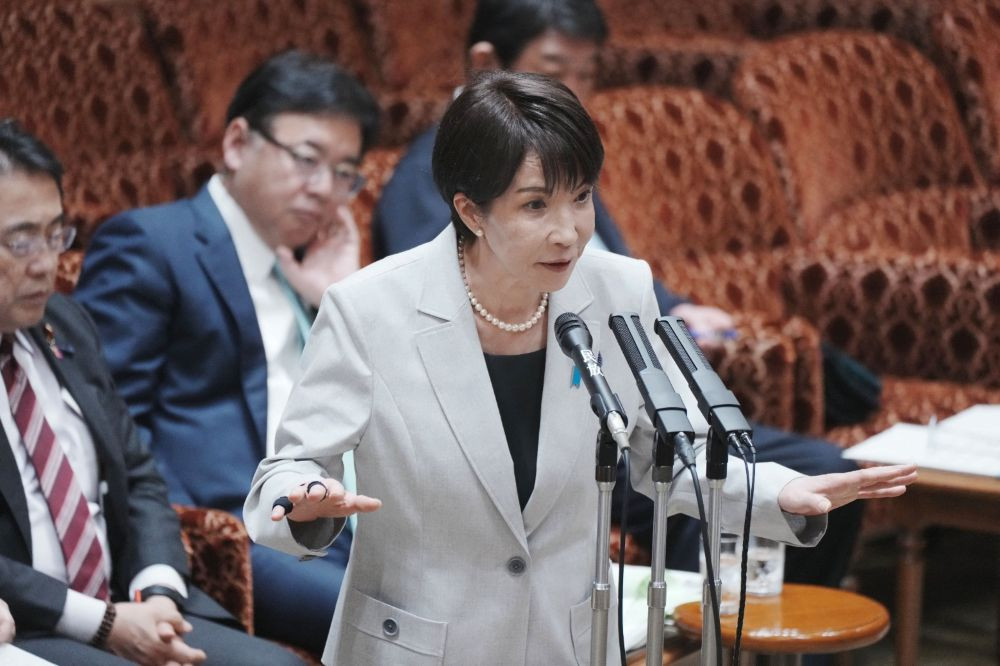 Japan's first-ever female prime minister, Sanae Takaichi, answers questions about the situation in the Middle East on April 7, 2026 during a budget committee session of the House of Councillors at Parliament in Tokyo. (AFP/Kazuhiro Nogi)
T
riggered by Japanese Prime Minister Sanae Takaichi’s remarks in the Diet on Nov. 7, 2025, China launched a wave of targeted sanctions against Japan. Beginning with a ban on seafood imports and voluntary restraints on tourism, these measures have since intensified to include restrictions on rare earth exports and Beijing's invocation of the World Trade Organization’s (WTO) security exceptions.
High-level leadership exchanges have ground to a halt, ministerial interaction is restricted to baseline Asia Pacific Economic Cooperation (APEC)-related events, and scholarships for Chinese students studying in Japan have been effectively terminated. In public discourse, Beijing frequently criticizes Tokyo for falling into “neo-militarism.”
Although the APEC summit is scheduled to take place in Shenzhen, China, in November of this year, and Prime Minister Takaichi is expected to attend, the prospects for diplomatic repair remain weak. Furthermore, given the impending leadership changes at the National Congress of the Communist Party of China in the autumn of 2027, Beijing is unlikely to take risks in its foreign policy anytime soon.
Why have Japan-China relations deteriorated to this extent? A primary catalyst was that Prime Minister Takaichi’s remarks specifically touched upon Taiwan. While discussing the hypothetical circumstances under which Japan could exercise the right of collective self-defense alongside the United States military under its peace constitution, she addressed an emergency in the Taiwan Strait as an illustrative example.
Historically, it has been customary for Japanese prime ministers to avoid definitive answers regarding whether collective self-defense would be deployed in specific, hypothetical scenarios. From Beijing's perspective, her answer implied that a military blockade of Taiwan by China would trigger a joint US-Japan military response, an interpretation the Xi Jinping administration regards as direct "interference in internal affairs".
Conversely, Tokyo maintains that its stance has not shifted. In early December 2025, Takaichi explicitly stated before a plenary session of the House of Councillors that Japan’s Taiwan policy remains entirely unchanged since the normalization of diplomatic relations in 1972.

However, it would be reductive to attribute this diplomatic deep-freeze solely to the November 2025 remarks. In reality, a rise in bilateral tensions across both military and economic spheres had long been anticipated.