TheJakartaPost
Please Update your browser
Your browser is out of date, and may not be compatible with our website. A list of the most popular web browsers can be found below.
Just click on the icons to get to the download page.


Popular Reads
Top Results
No results found. Please check your search term and try again
Can't find what you're looking for?
View all search results
Popular Reads
Top Results
No results found. Please check your search term and try again
Can't find what you're looking for?
View all search resultsBridging borders: The new Indonesia-China partnership
Beyond mere trade, Indonesia and China are forging an alliance to reshape regional finance, dominate the EV ecosystem and rewrite the rules of global governance in a new, high-stakes era.
Change text size
Gift Premium Articles
to Anyone
Share the best of The Jakarta Post with friends, family, or colleagues. As a subscriber, you can gift 3 to 5 articles each month that anyone can read—no subscription needed!
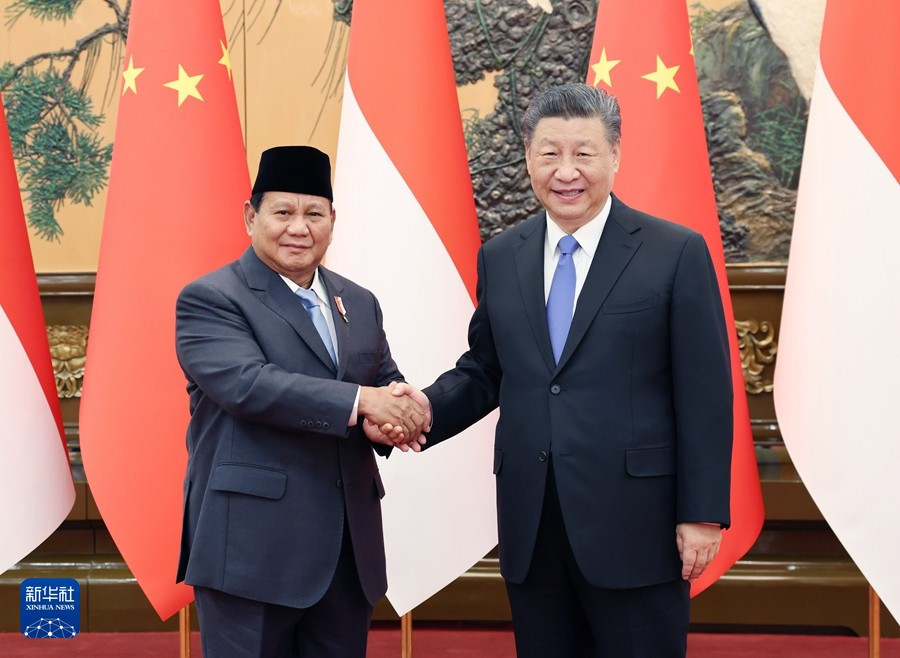 Defense Minister Prabowo Subianto (left) and Chinese President Xi Jinping shake hands on April 1, 2024, during their high-profile bilateral meeting in Beijing, China. (Courtesy of Xinhua News) (Courtesy of Xinhua/-)
A
s Indonesia and China navigate a rapidly changing global landscape, their bilateral relationship has entered a new phase marked by deeper economic collaboration, technological cooperation and shared engagement in shaping global governance.
Built upon decades of diplomatic ties and strengthened by mutual respect, the Indonesia-China relationship today transcends mere trade and investment: The two countries are focused on jointly creating opportunities for sustainable growth and contributing to a more stable international order.
China, with its Belt and Road Initiative (BRI), and Indonesia, guided by its enduring "independent and active" foreign policy, find a natural alignment. Indonesia’s participation ensures that the BRI remains an open platform for development rather than a polarizing geopolitical bloc. This balancing role is a direct reflection of Indonesia’s sovereign strategic doctrine, allowing the nation to foster deep partnerships without compromising its strategic neutrality.
In this new era, three areas stand out as particularly promising: financial cooperation, industrial transformation through electric vehicles and collaboration within multilateral institutions.
First is financial connectivity. One of the most significant recent developments is the growing financial cooperation between Indonesia and the Hong Kong Special Administrative Region, particularly in facilitating the use of the Indonesian rupiah in cross-border transactions. This initiative complements a recent milestone launched by Bank Indonesia and the People’s Bank of China to integrate the Quick Response Code Indonesian Standard (QRIS) into the cross-border payment ecosystem.
As Asia continues to emerge as the center of global economic growth, reducing dependence on third-country currencies enhances efficiency, lowers transaction costs and strengthens regional financial resilience. Expanded use of the rupiah in trade, investment and financial services involving Hong Kong, a leading international financial hub, represents an important step toward greater monetary cooperation.

Such initiatives support Indonesia’s broader objective to internationalize the rupiah in a prudent, gradual manner while providing businesses with more flexible settlement options. For both nations, stronger financial linkages contribute to a more diversified and resilient regional economic architecture capable of withstanding external shocks.