TheJakartaPost
Please Update your browser
Your browser is out of date, and may not be compatible with our website. A list of the most popular web browsers can be found below.
Just click on the icons to get to the download page.


Popular Reads
Top Results
No results found. Please check your search term and try again
Can't find what you're looking for?
View all search results
Popular Reads
Top Results
No results found. Please check your search term and try again
Can't find what you're looking for?
View all search resultsToward energy sovereignty: Indonesia’s sustainability imperative
A conflict in the Middle East is no longer a distant geopolitical issue for Indonesia—it is an immediate threat that has forced energy security and economic sovereignty to the absolute forefront. To survive global price shocks and supply risks, the nation must transform its energy transition from a climate agenda into a strategic shield by scaling domestic renewables, biofuels and regional supply networks.
Change text size
Gift Premium Articles
to Anyone
Share the best of The Jakarta Post with friends, family, or colleagues. As a subscriber, you can gift 3 to 5 articles each month that anyone can read—no subscription needed!
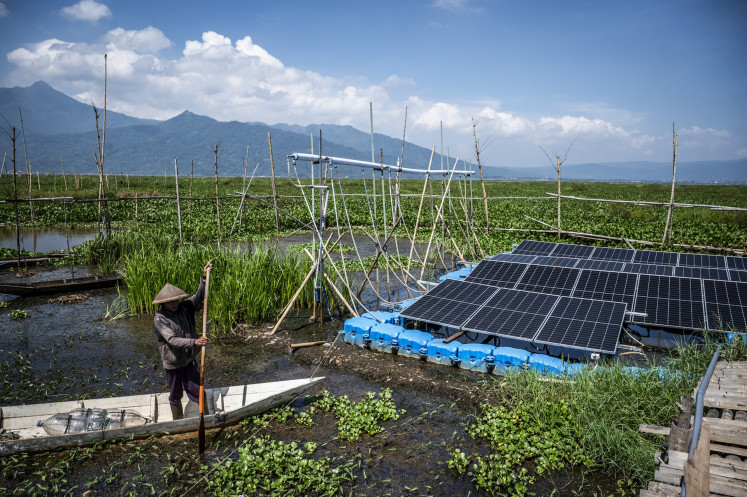
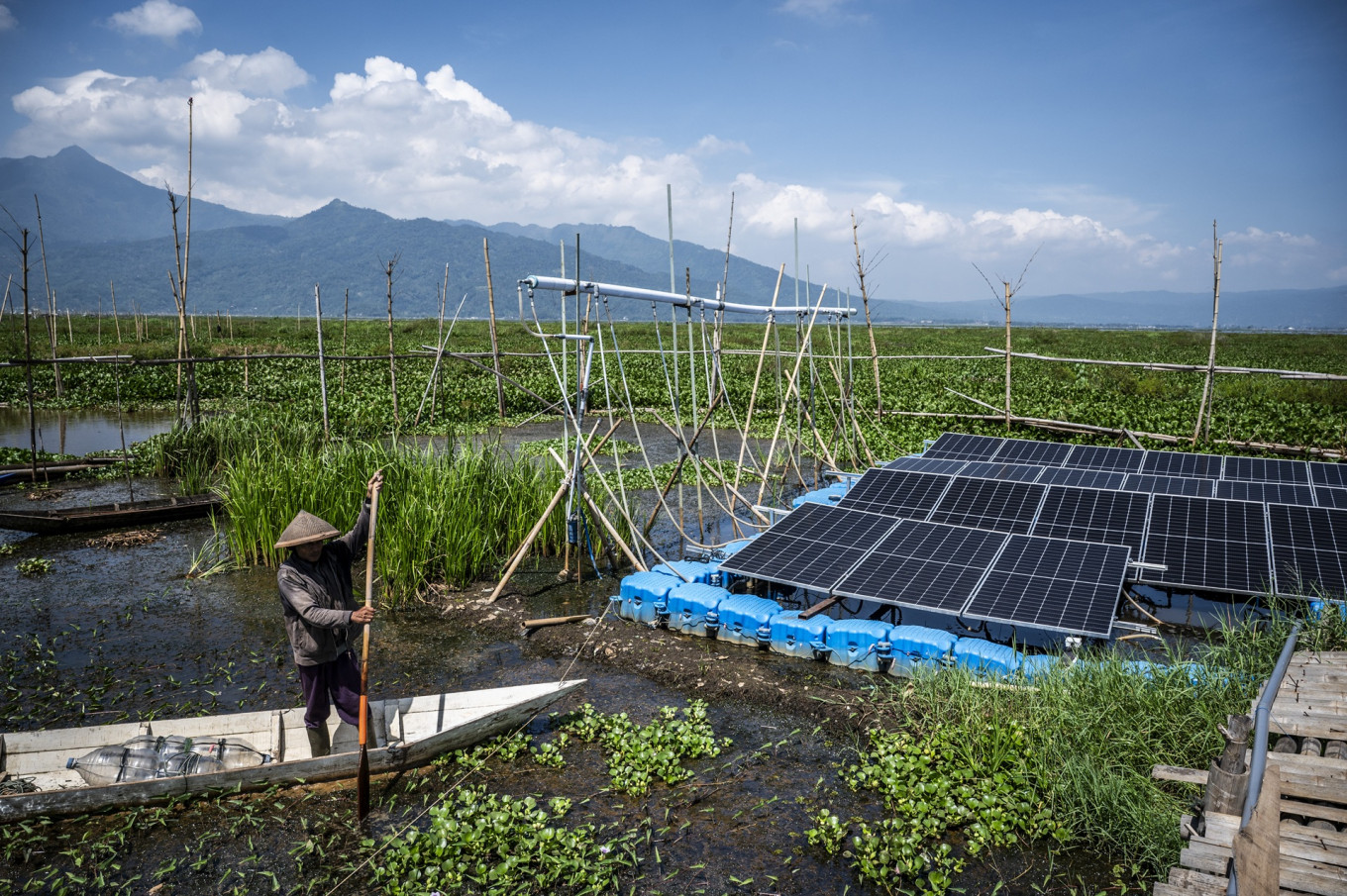 A farmer stands on a boat that passes through solar panels installed as part of the Rawa Pening floating solar photovoltaic plant in Tuntang, Semarang regency, Central Java on Oct. 12, 2025. (Antara/Aprillio Akbar)
T
he disruption in the Middle East has exposed the fragility of global energy systems. The Strait of Hormuz, one of the world’s most critical energy chokepoints, has become a reminder of how concentrated supply routes can trigger widespread price volatility and supply risk. For import-dependent economies such as Indonesia, this is not a distant geopolitical issue. It translates into immediate price increases, fiscal pressure and heightened energy insecurity.
As a result, the traditional energy trilemma is being redefined. Security and affordability now take precedence, while sustainability is increasingly valued for its role in strengthening resilience. In this context, the energy transition is no longer only a climate imperative. It is also a strategic tool to reduce import dependence and protect the economy from geopolitical shocks.
The Strait of Hormuz handled nearly 30 percent of global seaborne trade of oil and petroleum product flows. The strait is also a key transit route for fertilizer inputs such as sulfur, ammonia and urea; petrochemicals and industrial commodities; and critical materials including celestite, helium and aluminum.
Disruptions to Hormuz therefore affect importing countries across three dimensions: supply security, price volatility and logistics constraints.
Prior to the crisis, nearly 80 percent of LNG transiting through Hormuz was destined for Asian markets. ASEAN economies are therefore particularly vulnerable to supply and price shocks. Indonesia is no exception. The country relies on the Middle East for a significant share of its LPG, refined products and crude oil imports. While the government works to shield consumers from global oil price increases, this comes at the cost of rising fiscal strain.
What begins as a conflict in the Middle East quickly becomes an economic reality for import-dependent countries like Indonesia. This evolving geopolitical landscape calls for a strategic pivot toward energy sovereignty, where security and affordability take precedence. Decarbonization remains critical, but it must be pursued through a more pragmatic lens, prioritizing pathways that also enhance energy independence and economic stability.

The Middle East conflict has fundamentally reshaped the traditional energy trilemma. The immediate scramble for physical supply has pushed energy security firmly to the forefront. The trilemma is no longer simply a balancing act. In the short term, it has become sequential: security first, affordability second and sustainability reimagined to support both.