TheJakartaPost
Please Update your browser
Your browser is out of date, and may not be compatible with our website. A list of the most popular web browsers can be found below.
Just click on the icons to get to the download page.


Popular Reads
Top Results
No results found. Please check your search term and try again
Can't find what you're looking for?
View all search results
Popular Reads
Top Results
No results found. Please check your search term and try again
Can't find what you're looking for?
View all search resultsOur jobless youth
A national internship program won't save Indonesia’s stalling demographic bonus unless the government addresses the real crisis: a severe shortage of formal jobs.
Change text size
Gift Premium Articles
to Anyone
Share the best of The Jakarta Post with friends, family, or colleagues. As a subscriber, you can gift 3 to 5 articles each month that anyone can read—no subscription needed!
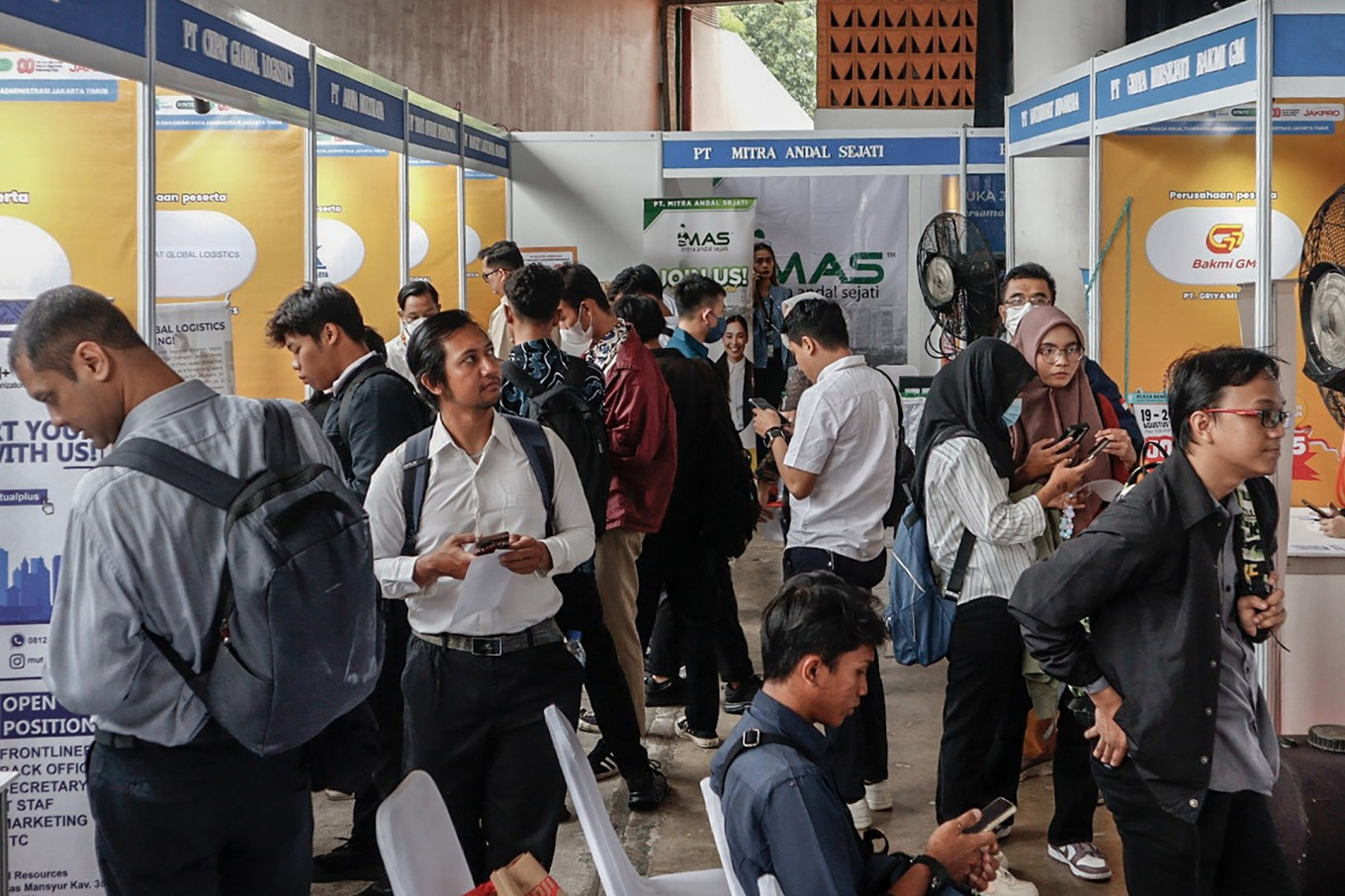 Job seekers visit company booths on Aug. 19, 2025, at a job fair in Jakarta. (Antara/Muhammad Rizky Febriansyah)
F
or years, successive governments have touted the country’s demographic bonus, a golden window where the working age population outnumbers the nonproductive population, as the definitive ticket to achieving high-income status by 2045. However, without a sufficient number of high-quality jobs for young people, this demographic windfall risks rapidly devolving into a national burden.
The structural cracks are already showing. The October 2025 edition of the World Bank's East Asia and Pacific Economic Update highlighted Indonesia’s youth unemployment rate of 17.3 percent: among the highest in Asia that trails only India.
Recent data from Statistics Indonesia (BPS) paint an equally troubling picture: The unemployment rate among Indonesians aged 15-24 has crept up to 16.36 percent from 16.16 percent a year ago.
Even those fortunate enough to find jobs face a precarious reality: only 40.58 percent is in the formal sector. The vast majority remain trapped in informal employment characterized by unsteady incomes, zero safety nets and nonexistent career pathways.
If this trend hardens, youth unemployment will leave deep, permanent scars on the economy. A jobless youth is not merely a missing worker but also a missing taxpayer, a delayed homeowner, a postponed parent and an untapped potential contributor to the national pension system.
Against this worrying backdrop, the government deserves credit for launching a national internship program that connects fresh graduates with private companies, which also includes a partly subsidized salary. Rather than recycling the classroom-only training framework of past initiatives, this program directly targets the primary barrier confronting young job seekers: a lack of practical experience.

The initial metrics are encouraging. More than 76,000 fresh graduates flooded the first two cohorts, prompting the government to double its target to 150,000 for the next cycle. According to Manpower Minister Yassierli, around 35 percent of the 14,000 participants in the inaugural group, or 4,900, have transitioned into full-time jobs at their host companies.
Meanwhile, interns have praised the initiative as a welcome departure from previous preemployment schemes, which offered training in a vacuum without any real-world pathways to permanent employment.
Yet the government must not mistake a promising pilot program for a systemic cure. The sheer scale of the youth employment crisis vastly eclipses what an internship scheme can resolve.
To move the needle, the program must scale up and pivot toward vocational school (SMK) graduates, the very demographic trained to be job-ready. Ironically, BPS data reveal that the unemployment rate among SMK graduates is the highest among all secondary schools at 7.74 percent.
The government must also forge closer engagement with industry leaders to ensure that these state-backed internships are universally recognized as legitimate work experience.
Perhaps Indonesia can learn from Germany’s famous Ausbildung vocational system. Transitioning to this type of integrated, formally regulated system will compel local companies to invest in young talent based on genuine operational needs rather than relying on temporary state subsidies.
Most fundamentally, however, policymakers must realize that the primary labor crisis is not a shortage of employable workers but a severe shortage of jobs. Connecting young people to the labor market is a futile exercise if the market itself is stagnant. As automation and artificial intelligence rapidly reshape global labor dynamics, the danger is that entry-level opportunities will grow at a fraction of the speed by which the youth population is entering the workforce.
The government’s homework ultimately lies in macroeconomics: creating an ecosystem where employers are eager to invest, expand and hire. This requires aggressively supporting labor-intensive industries, slashing bureaucratic barriers for start-ups and maintaining the regulatory predictability needed to attract long-term domestic and foreign capital.
If the state fails to ignite genuine job creation, the celebrated demographic bonus will not be remembered as the engine that propelled the nation to prosperity. Instead, it will stand as a tragic monument to a once-in-a-generation opportunity that quietly slipped away.