TheJakartaPost
Please Update your browser
Your browser is out of date, and may not be compatible with our website. A list of the most popular web browsers can be found below.
Just click on the icons to get to the download page.


Popular Reads
Top Results
No results found. Please check your search term and try again
Can't find what you're looking for?
View all search results
Popular Reads
Top Results
No results found. Please check your search term and try again
Can't find what you're looking for?
View all search resultsWhen the KPK enters the core of party power
While anticorruption efforts usually focus on handcuffs and press conferences, the KPK is finally looking "upstream" at the political parties that fuel the crisis. By challenging the corporate-style control of party elites, the KPK is no longer just chasing criminals—it is trying to rewrite the rules of power itself.
Change text size
Gift Premium Articles
to Anyone
Share the best of The Jakarta Post with friends, family, or colleagues. As a subscriber, you can gift 3 to 5 articles each month that anyone can read—no subscription needed!
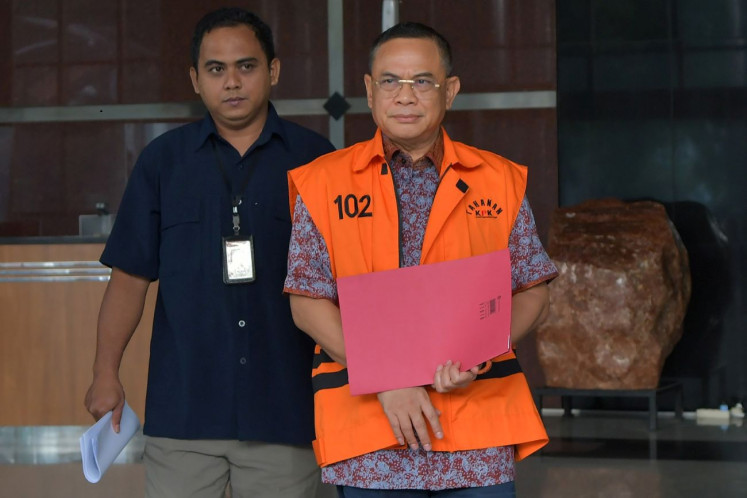
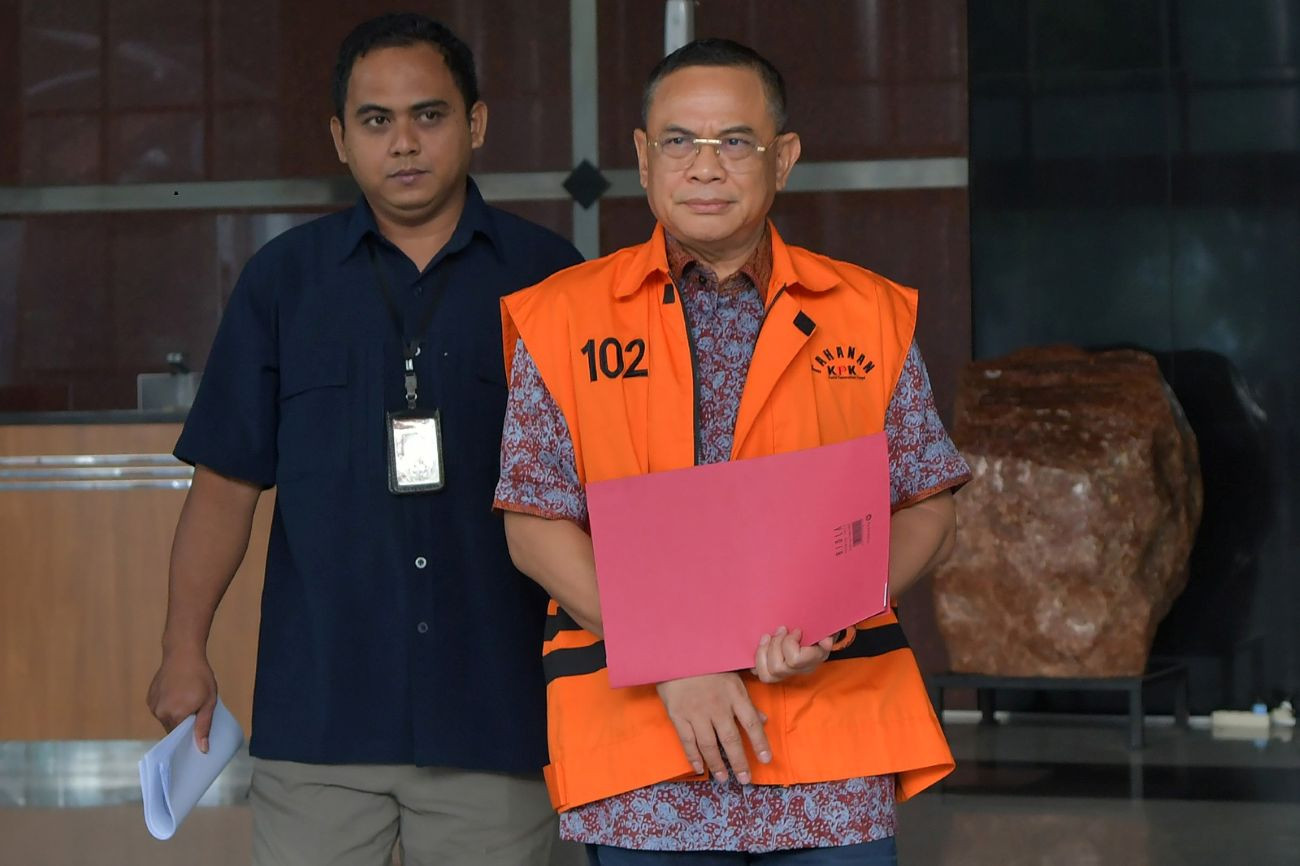 Endemic symptom: Pati Regent Sudewo (right), a Gerindra Party politician, is escorted on April 16, 2026 following his interrogation at the Corruption Eradication Commission (KPK) headquarters in Setiabudi, South Jakarta, in relation to extortion allegations involving village officials. (Antara/Reno Esnir)
C
orruption in Indonesia has long been treated as a series of isolated events, attributed to individual misconduct rather than the system that produces it. The cycle is predictable: a sting operation, officials in handcuffs, a press conference and then closure. The problem appears contained, even as the underlying structure remains intact.
Yet corruption does not emerge in a vacuum. It is constructed, and its primary breeding ground is the political party.
This is why the Corruption Eradication Commission’s (KPK) recent move to examine political party governance has triggered such strong reactions. The issue is no longer just about who gets arrested, but how individuals reach positions of power in the first place.
The KPK’s findings are hardly new: high political costs, opaque recruitment, weak bureaucrat development and entrenched elite dominance are well-recognized structural failures. However, these problems become politically unsettling when formally articulated by an institution with the authority to demand change.
The KPK explicitly points to the high cost of politics as a driver for "return on investment" logic once officials assume office. This aligns with academic observations. Vedi R. Hadiz has described Indonesian democracy as an adaptation of oligarchic structures, while Marcus Mietzner highlights the weak institutionalization of parties alongside powerful patronage networks. In such a system, personal relationships override formal rules, making corruption a produced outcome rather than a mere anomaly.
In this context, the KPK’s intervention is disruptive because it shifts the focus from actors to patterns. One of its most controversial proposals is limiting the tenure of party chairpersons.

While such measures are standard in modern organizations, in Indonesia, they touch the nerve center of power. Major parties—Indonesian Democratic Party of Struggle (PDI-P) under Megawati Soekarnoputri, NasDem Party under Surya Paloh, Gerindra Party under Prabowo Subianto and Perindo under Hary Tanoesoedibjo—do not merely follow these figures; they revolve around them. Here, leadership transition is not procedural; it is structural.