TheJakartaPost
Please Update your browser
Your browser is out of date, and may not be compatible with our website. A list of the most popular web browsers can be found below.
Just click on the icons to get to the download page.


Popular Reads
Top Results
No results found. Please check your search term and try again
Can't find what you're looking for?
View all search results
Popular Reads
Top Results
No results found. Please check your search term and try again
Can't find what you're looking for?
View all search resultsThe irony of Indonesia's disposable labor regime
While the elite debates the fine print of formal labor laws, a disposable workforce of millions remains legally invisible and economically exploited. This systemic engineering of precarity has not only widened inequality but also left Indonesia 30 percent less efficient than its regional peers.
Change text size
Gift Premium Articles
to Anyone
Share the best of The Jakarta Post with friends, family, or colleagues. As a subscriber, you can gift 3 to 5 articles each month that anyone can read—no subscription needed!
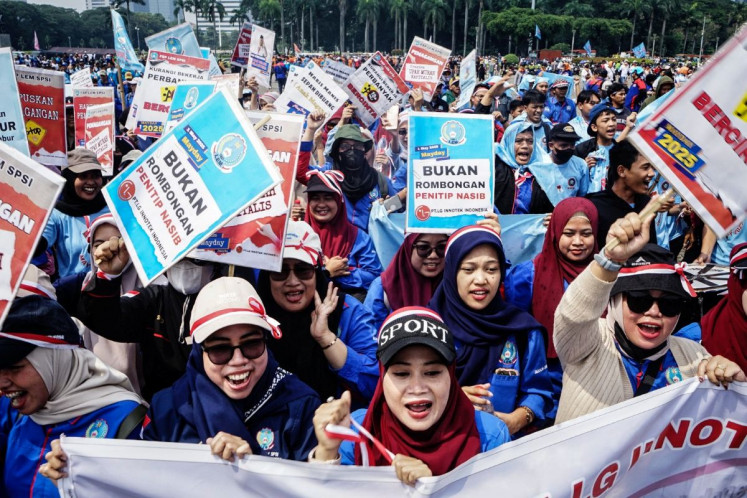
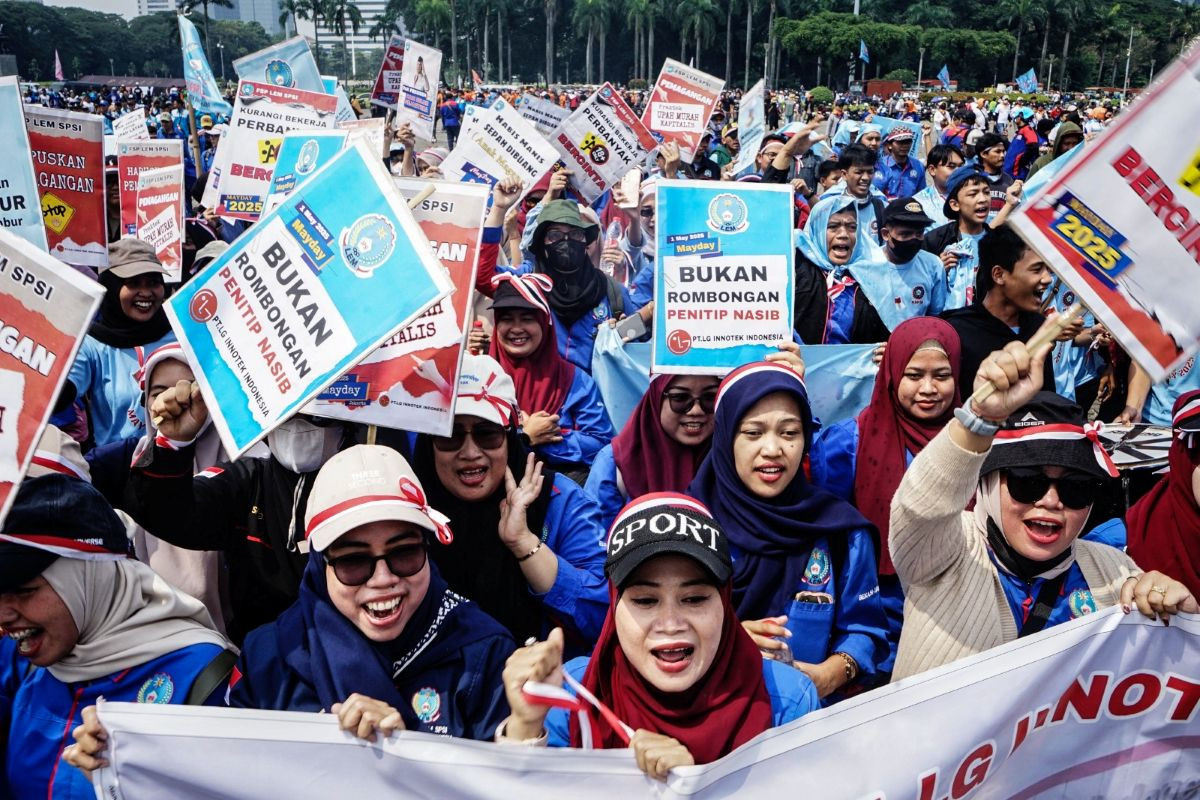 Raucous cheer: Labor union members hold banners and wave posters on May 1, 2025, during a Labor Day rally in Jakarta. (AFP/Azwar Ipank)
Y
ear after year, International Labor Day has been marked by workers taking to the streets with a familiar set of placards: abolish outsourcing, stop mass layoffs, raise the minimum wage and pass the new Manpower Law mandated by the Constitutional Court’s 2024 ruling. Union leaders themselves acknowledge that this year’s demands are largely a repetition of those raised before.
The structural conditions producing these demands have not shifted. But repetition itself is data.
Even the Constitutional Court has formally recognized that the current legal framework cannot deliver decent work. Yet its order to draft a new Manpower Law within two years addresses only the visible upper layer of Indonesia’s labor architecture.
Beneath that layer sits a far larger population that no statutory reform has even begun to map. Outside the formal labor framework is a segment numbering in the millions, and whose conditions worsen each year while political discourse stays trained on a narrow band of grievances from the formal sector.
The deeper question this May Day extends well beyond outsourcing: It concerns the workers engineered to be disposable, by law and by contract design.
In labor sociology, the term "disposable worker" describes a labor force that is structurally designed to be moved, cut and replaced at minimal cost. Employers bear no long-term obligation, business risk shifts to labor, and legal classification is engineered to fall outside standard protections.

The International Labour Organization reports the global labor income share has fallen 0.6 percentage points since 2019, with US$2.4 trillion transferred from workers to capital owners in 2024 alone.