TheJakartaPost
Please Update your browser
Your browser is out of date, and may not be compatible with our website. A list of the most popular web browsers can be found below.
Just click on the icons to get to the download page.


Popular Reads
Top Results
No results found. Please check your search term and try again
Can't find what you're looking for?
View all search results
Popular Reads
Top Results
No results found. Please check your search term and try again
Can't find what you're looking for?
View all search resultsEU to propose diversification law to drive de-risking from China
The European Commission will propose a new law requiring EU companies to diversify their sources of key supplies, its president Ursula von der Leyen has said, while China urged the G7 nations to respect market economy principles and international trading rules.
Change text size
Gift Premium Articles
to Anyone
Share the best of The Jakarta Post with friends, family, or colleagues. As a subscriber, you can gift 3 to 5 articles each month that anyone can read—no subscription needed!
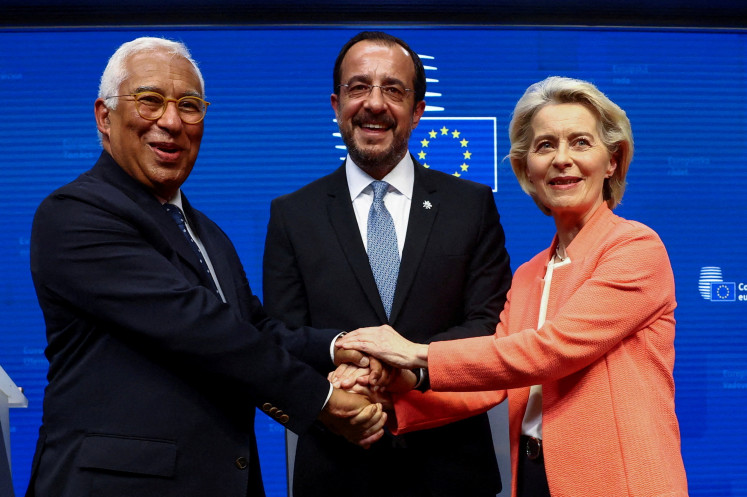
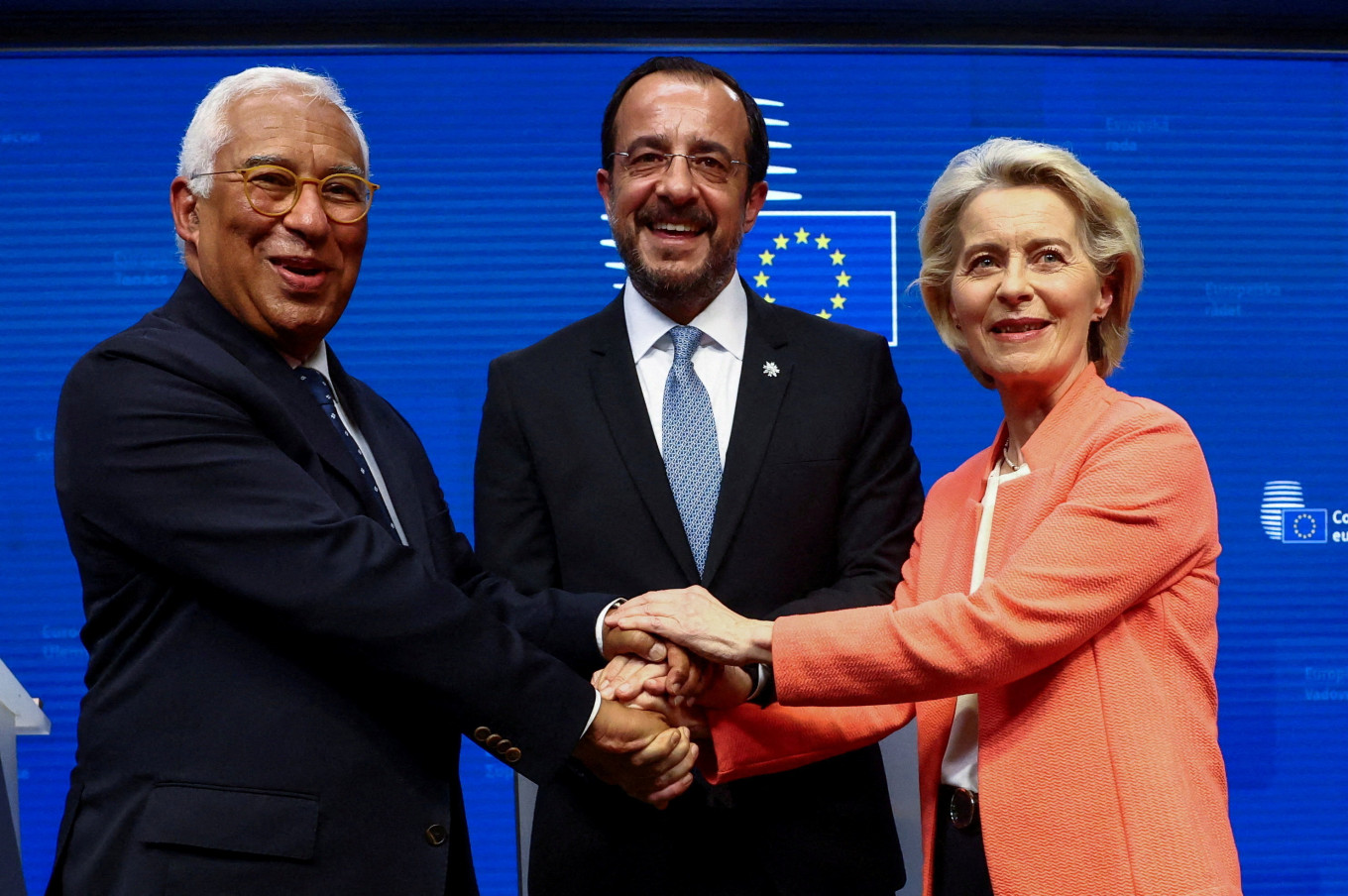 European Council President Antonio Costa and European Commission President Ursula von der Leyen congratulate Cyprus President Nikos Christodoulides on the Cyprus' European Union presidency, following a European Union leaders' summit in Brussels on June 19, 2026. (Reuters/Yves Herman)
T
he European Commission will propose a new law requiring EU companies to diversify their sources of key supplies, although it may prove surplus to requirements if they proactively de-risk from China, its president Ursula von der Leyen said.
European Union leaders meeting in Brussels agreed on Friday that the EU executive should enter dialogue with the bloc's main trading partners on "global macroeconomic imbalances" as well as reviewing whether new trade measures are needed.
The focus was on China, although the world's second-largest economy was not named in the conclusions of their summit.
Von der Leyen said the Commission will propose a measure to promote diversification because businesses had de-risked at far too slow a pace. The issue came to a head last year when China exploited its dominance in processing of critical minerals by placing export restrictions on rare earths.
The best-case scenario was that companies stepped up their efforts to de-risk, suggesting the measure might then be redundant, von der Leyen said.
"There is a need for improvement. We've seen the figures, they speak for themselves, and we have to rebalance our relationship," she added.

When the G7 issued a joint statement on Wednesday on stepping up cooperation to reduce critical mineral dependencies, China urged the G7 nations to respect market economy principles and international trading rules rather than favoring "small cliques".
EU diplomats say there is a gradual convergence of views among the 27 EU members that there is a problem with the goods trade deficit with China, which now amounts to some 1 billion euros (US$1.15 billion) per day.
The situation is more critical as transatlantic tariffs have diminished access to the US market.
European Council President Antonio Costa, who chaired the summit, said engagement with China was vital, describing a €1 billion per day trade deficit as "simply unsustainable".
"We cannot continue to raise this issue without any concrete results. And until now, unfortunately, China didn't deliver," Costa said.
Belgian Prime Minister Bart De Wever said a further item the EU leaders had agreed was to unite in the event of retaliation from third countries.
"Retaliation will not affect everyone equally. Not everyone is equally vulnerable. Some are highly vulnerable. Everyone is vulnerable to some extent, including us," he said.